Introduction
As a founder or growth leader, you know that generating insights and executing strategy often feels like juggling multiple tasks at once. AI can accelerate decision-making—but only if you know how to feed it structured, multi-step instructions. This is where a business prompt sequence comes in. By standardizing and sequencing your prompts, you ensure consistent, actionable outputs that save time, reduce mistakes, and improve strategy quality.
What Is a Prompt Sequence?
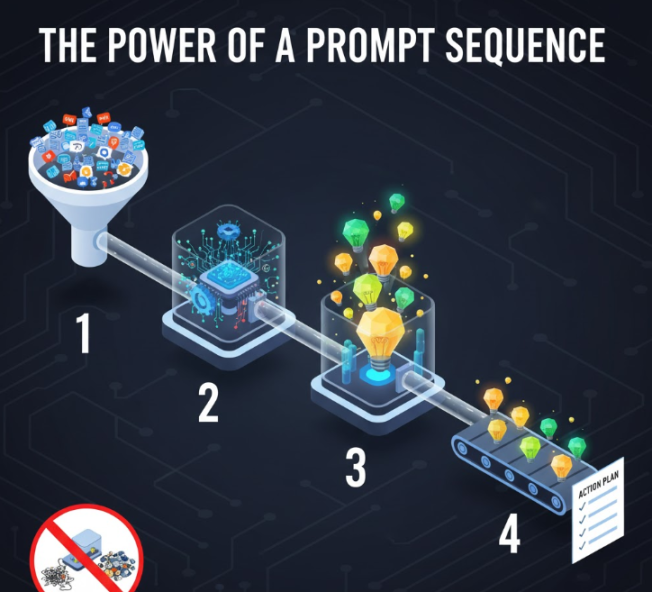
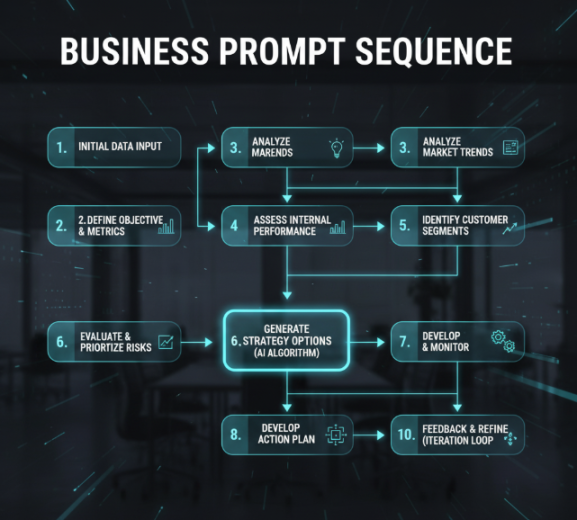
A prompt sequence is a series of connected instructions given to an AI model to achieve a specific business outcome. Unlike single-step prompts, which may produce inconsistent or shallow results, a multi-step prompt guides the AI through structured reasoning, data analysis, or content creation.
Benefits of Multi-Step Prompts
- Consistency: Produces repeatable, high-quality outputs.
- Clarity: Reduces ambiguity in AI responses.
- Efficiency: Automates complex workflows with fewer iterations.
- Scalability: Easy to share and standardize across teams.
Common Business Prompt Sequences
- Funnel Analysis Sequence:
- Step 1: Collect historical funnel data.
- Step 2: Identify bottlenecks.
- Step 3: Suggest optimizations.
- Step 4: Generate a prioritized action list.
- Offer Optimization Sequence:
- Step 1: Input current offer details.
- Step 2: Benchmark competitors.
- Step 3: Identify missing value propositions.
- Step 4: Recommend pricing or messaging adjustments.
- Content Planning Sequence:
- Step 1: Define target audience.
- Step 2: Analyze trending topics.
- Step 3: Draft content ideas.
- Step 4: Suggest SEO-focused headlines.
Best Practices for Creating Prompt Sequences
- Start Small: Begin with 2–3 steps and iterate.
- Define Clear Inputs & Outputs: Specify the format and level of detail expected.
- Use Templates: Standardize common sequences for repeatable workflows.
- Document Everything: Maintain version logs and instructions for team adoption.
- Test & Refine: Review AI outputs and adjust sequence steps as needed.
Checklist: Ensure each prompt sequence has:
- Step-by-step instructions
- Clear input data
- Expected output format
- Validation criteria
FAQ
1. What’s the difference between a prompt and a prompt sequence?
A single prompt gives one instruction to the AI, while a prompt sequence guides the AI through multiple steps for a more complete and consistent output.
2. Can teams share prompt sequences?
Yes. Documented sequences are easy to distribute across teams, ensuring everyone follows best practices.
3. How many steps should a prompt sequence have?
Typically 3–6 steps work well. More complex workflows can have additional steps but should remain manageable.
4. Do prompt sequences improve AI model performance?
While they don’t change the underlying model, sequences enhance output quality, accuracy, and relevance by providing structured guidance.
5. Are prompt sequences only for marketing?
No. They can be applied to product strategy, financial analysis, customer support, and any workflow where AI can assist decision-making.
Conclusion
Ready to optimize your business strategy with multi-step prompts? Explore ActStrategic.ai’s AI strategy tools to create, test, and standardize prompt sequences that drive smarter, faster business decisions.