Introduction
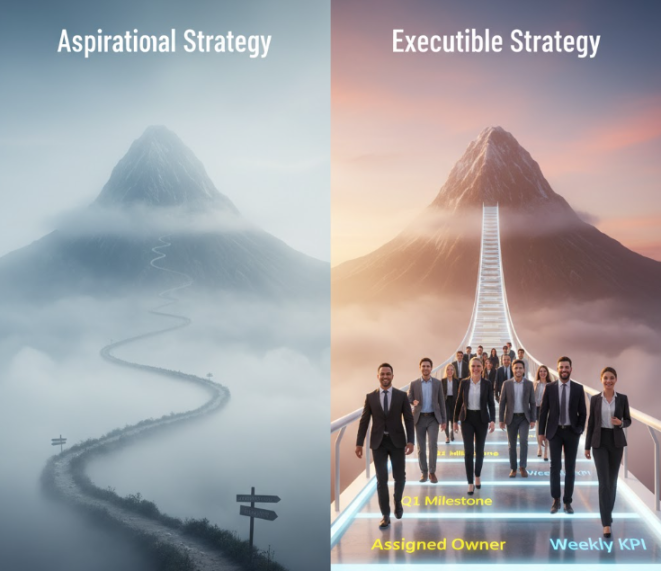
Every founder and operator has experienced the frustration of a strategy that looks great on paper but fails in execution. Aspirational plans often inspire, but without clear steps, metrics, and accountability, they rarely move the needle. The key difference? Executable strategies are practical, actionable, and designed for real-world implementation.
With AI strategy tools like ActStrategic.ai, you can turn ambitious goals into a step-by-step plan that your team can follow and track.

Understanding Executable vs. Aspirational Strategy
| Trait | Aspirational Strategy | Executable Strategy |
|---|---|---|
| Goal Type | Big-picture, often vague | Specific, measurable, and achievable |
| Timeline | Long-term vision without clear milestones | Defined milestones and deadlines |
| Accountability | Often no clear ownership | Roles and responsibilities assigned |
| Metrics | Broad or inspirational | Concrete KPIs and performance metrics |
| Actionability | Inspires but rarely guides action | Directly guides daily or weekly execution |
Aspirational strategies fail when teams don’t know what to do next. Executable strategies bridge vision and reality, ensuring every step contributes to measurable outcomes.
How AI Enhances Strategic Execution
AI tools can convert high-level goals into executable plans by:
- Prioritizing initiatives: Rank projects by ROI, effort, or urgency.
- Defining KPIs: Suggest clear, measurable metrics aligned with company goals.
- Creating workflows: Break objectives into daily, weekly, and monthly action items.
- Monitoring progress: Track milestones, detect bottlenecks, and provide alerts.
- Generating insights: Highlight opportunities or risks that humans might overlook.
For example, using ActStrategic.ai you can input your business goals and receive a structured plan with priority tasks, KPIs, and deadlines — all tailored to your funnel or offer strategy.
Practical Steps to Make Your Strategy Executable
- Set Clear Objectives: Define what success looks like in measurable terms.
- Break Down Goals: Divide high-level objectives into manageable tasks.
- Assign Ownership: Ensure each action item has a responsible person.
- Establish KPIs: Track outcomes with concrete metrics.
- Review and Adjust: Schedule weekly or monthly check-ins to update priorities.
- Leverage AI Assistance: Use AI prompts to generate workflows, checklists, and risk assessments quickly.
Common Mistakes to Avoid
- Overcomplicating the plan: Keep tasks simple and actionable.
- Ignoring metrics: If you can’t measure it, you can’t manage it.
- Skipping accountability: Assigning tasks ensures follow-through.
- Treating AI as a replacement: Use AI as a partner, not a substitute for decision-making.
FAQs
1. What is an executable strategy?
An executable strategy is a practical, action-oriented plan that clearly outlines what needs to be done, by whom, and by when to achieve business objectives.
2. How does it differ from an aspirational strategy?
Aspirational strategies inspire but often lack actionable steps, KPIs, or ownership. Executable strategies translate vision into concrete actions.
3. Can AI make a strategy more executable?
Yes. AI tools like ActStrategic.ai prioritize initiatives, define KPIs, and create actionable workflows to ensure strategies are actionable.
4. What role do KPIs play in execution?
KPIs provide measurable targets, allowing teams to track progress and adjust strategies as needed.
5. How do I avoid creating an overly complex plan?
Focus on high-impact tasks, assign clear ownership, and use AI to break down complex goals into simple, actionable steps.
6. Are AI-generated strategies flexible?
Absolutely. AI assists in scenario planning, allowing you to adapt plans based on real-time data and evolving business conditions.
Conclusion
To make your business strategy truly executable, explore how ActStrategic.ai can help you generate actionable plans, prioritize initiatives, and track progress — all in a fraction of the time it takes manually.