✍️ Introduction: Why Funnels Fail and How to Spot It
Every business funnel has weak points. Low lead conversion, abandoned carts, or poor ad ROI are often symptoms of deeper structural issues. A systematic funnel diagnosis ensures you identify bottlenecks fast, saving time and revenue.

📚 A Simple Funnel Diagnosis Framework
Use this repeatable funnel framework to audit any business funnel:
Step 1: Map Your Funnel
- Define stages: Awareness → Consideration → Conversion → Retention.
- Identify key metrics: CTR, engagement rate, conversion rate, LTV.
Step 2: Data Collection & Baseline Analysis
- Collect performance data from CRM, website analytics, ad platforms.
- Use AI tools like ActStrategic.ai to synthesize metrics quickly.
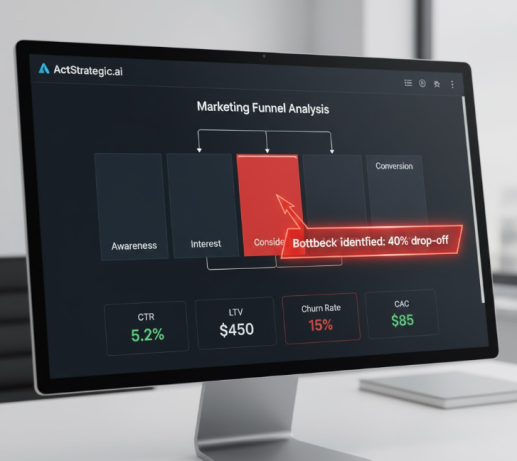
Step 3: Identify Bottlenecks
- Compare expected vs actual conversion rates at each stage.
- Look for anomalies such as high drop-offs or low engagement.
- Sample AI prompt: “Analyze conversion drop between landing page and checkout and suggest fixes.”
Step 4: Hypothesis & Test Plan
- Hypothesize reasons for bottlenecks (messaging, UX, offer mismatch).
- Create test plans for each issue (A/B tests, content tweaks, funnel sequencing).
Step 5: Actionable Recommendations
- Prioritize fixes by impact and effort.
- Generate step-by-step implementation plan with AI assistance.
Image alt text suggestion: Example funnel audit dashboard with stage-by-stage metrics
⚡ Common Funnel Mistakes to Avoid
- Ignoring micro-metrics at each stage.
- Testing too many variables simultaneously.
- Overlooking customer behavior insights.
- Relying solely on intuition instead of data.
❓ FAQs: Funnel Diagnosis & Framework
1. How often should I audit my funnel?
Quarterly audits are recommended, but high-growth campaigns may require monthly checks.
2. Can AI identify funnel bottlenecks automatically?
Yes, platforms like ActStrategic.ai analyze data, highlight issues, and recommend improvements.
3. What metrics are most important in a funnel audit?
Conversion rates, engagement metrics, CTR, bounce rates, LTV, and churn.
4. How do I know if the fixes worked?
Monitor KPIs post-implementation and compare with baseline performance.
5. Can this framework apply to both e-commerce and SaaS funnels?
Absolutely. The stages and metrics may differ slightly, but the core framework is universal.
6. Are there tools to automate testing and analysis?
Yes, AI-assisted platforms like ActStrategic.ai streamline testing, analysis, and reporting.
Conclusion
Start diagnosing your funnel smarter and faster. Explore ActStrategic.ai tools to generate a personalized funnel report and actionable recommendations today.