Why AI Strategy Matters More Than Ever
Artificial intelligence is no longer a buzzword — it’s a boardroom priority. According to McKinsey, companies that embed AI into core business processes report 20–30% improvements in efficiency and ROI compared to peers still dabbling with pilots. Harvard Business Review adds that AI-driven organizations are twice as likely to outperform competitors in revenue growth.
The takeaway: AI is moving from experimental to essential. Founders and strategy leaders who treat AI as a tactical tool risk falling behind. Those who embed AI into their core strategy create a durable competitive advantage.
Common Mistakes Founders Make With AI
Many leaders get excited about AI but stumble into the same traps:
- Treating AI as a bolt-on tool → Running isolated chatbots or dashboards with no strategic impact.
- Endless pilots with no ROI → Investing in prototypes that never scale or link back to business outcomes.
- Chasing tech, not strategy → Buying tools without aligning them to growth, efficiency, or customer value.
- Ignoring change management → Underestimating the need for cultural adoption and leadership alignment.
The result? Wasted budget, frustrated teams, and no competitive edge.
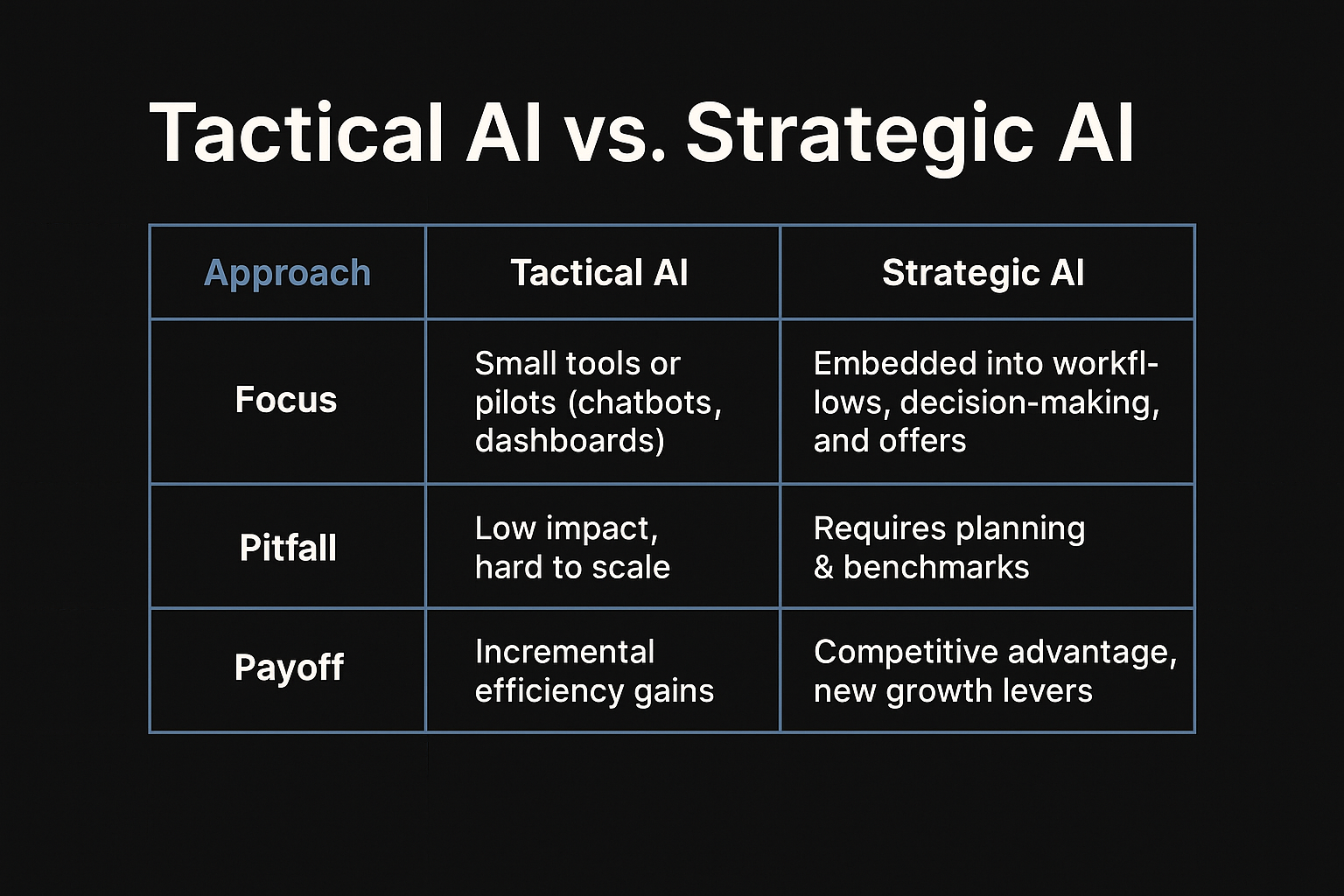
Tactical vs Strategic AI: What’s the Difference?
| Approach | Focus | Pitfall | Payoff |
|---|---|---|---|
| Tactical AI | Small tools or pilots (chatbots, dashboards) | Low impact, hard to scale | Incremental efficiency gains |
| Strategic AI | Embedded into workflows, decision-making, and offers | Requires planning & benchmarks | Competitive advantage, new growth levers |
Key Insight: Tactical AI saves time. Strategic AI reshapes how you compete.
Frameworks to Turn AI Into Advantage
To move beyond hype, founders can apply a three-lever framework:
| Lever | Focus | Example Impact | SMB Benchmark |
|---|---|---|---|
| Efficiency | Automate repetitive workflows | Cut manual reporting time by 50% | 30–40% productivity gain in SMB ops (PwC) |
| Insights | Unlock smarter decisions | Predict churn 3 months earlier | Reduce churn from 5–7% to <3% |
| Differentiation | Create new value for customers | Personalized bundles boost AOV 15% | Top SMBs see 10–20% higher repeat purchase rates |
Founders who activate all three levers — not just efficiency — build lasting advantage.
Mini Example:
A $10M SaaS company plateaued despite strong sales. After running an AI-driven churn analysis, they discovered 20% of cancellations came from a single onboarding gap. By redesigning that workflow with AI-powered nudges, churn dropped from 6% to 4% — unlocking $2M in retained revenue.
Step-by-Step: How to Use AI for Business Strategy
Here’s how to turn AI into a competitive advantage in five steps:
- Assess your workflows → Where does your team spend the most manual time?
- Identify bottlenecks and levers → Which processes slow growth or cost money unnecessarily?
- Benchmark against peers → Use consulting frameworks or tools like ActStrategic.ai to see how you stack up.
- Deploy quick wins → Start with 1–2 automations or insights that deliver ROI within 30 days.
- Scale strategically → Embed AI into decision-making, product strategy, and customer experience.
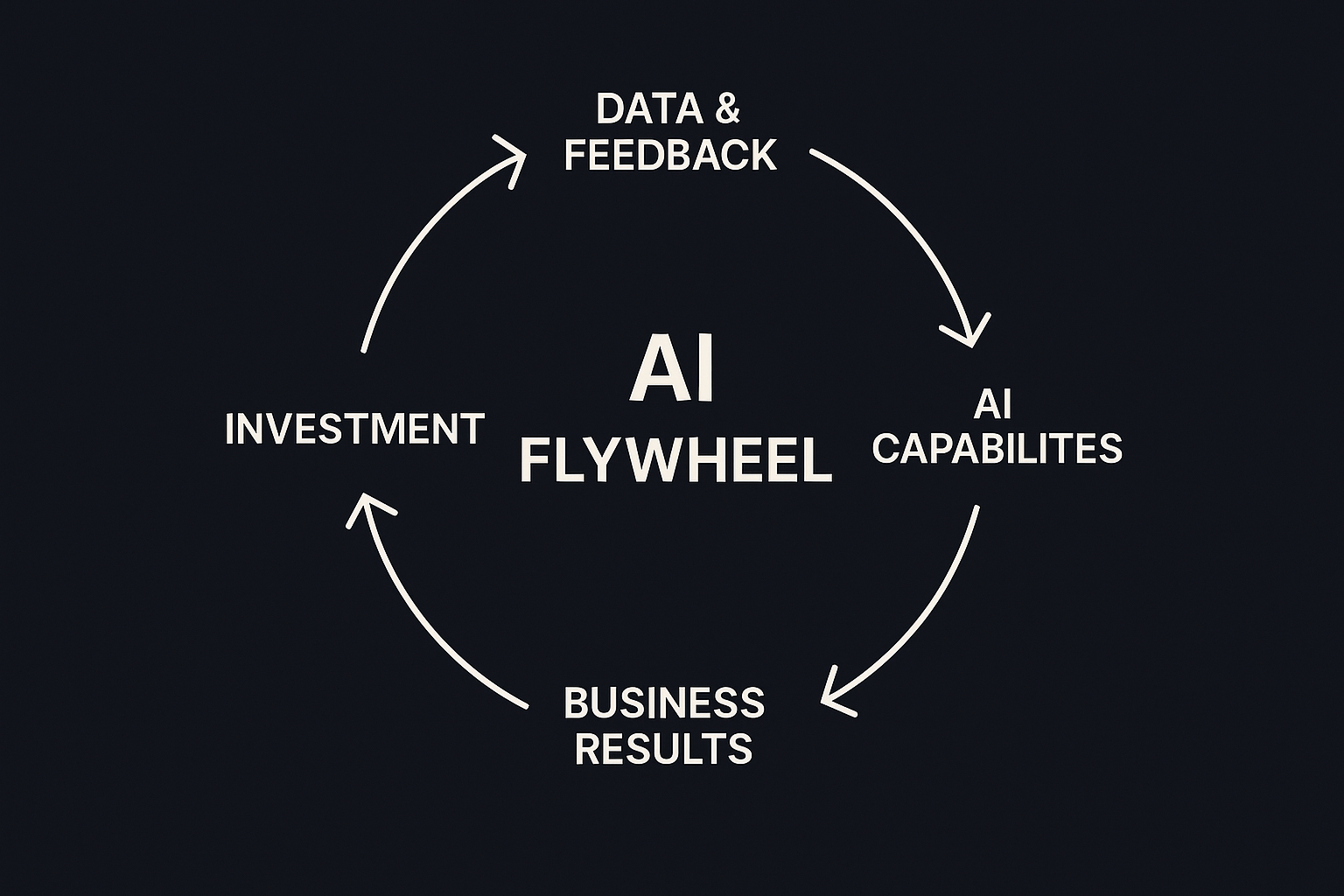
Visual Suggestion: An AI strategy flywheel showing how Quick Wins → Efficiency Gains → Deeper Insights → Differentiation → Growth reinforces itself over time.
Real-World AI Strategy Consulting Examples
Case Study 1 — Retail Operations
McKinsey found that AI-enabled inventory systems helped retailers reduce stockouts by 30–50% while lowering excess inventory by 20%. This didn’t just cut costs — it improved customer loyalty by ensuring products were always available.
Case Study 2 — B2B Sales
BCG reported that enterprise software companies using AI to prioritize leads saw 50% higher conversion rates in sales pipelines. AI didn’t just automate tasks — it made strategic selling more effective.
SMB Takeaway: Even small companies can replicate these results by applying the same frameworks at their scale. Efficiency, insights, and differentiation are universal levers.

FAQs
1. What is an AI strategy in business?
AI strategy means embedding AI into the core decision-making and operations of your business — not treating it as a side experiment.
2. How is AI different from traditional automation?
Automation saves time by handling repetitive tasks. AI adds a strategic layer by enabling predictions, personalization, and new business models.
3. What are examples of AI strategy consulting?
Consultants use frameworks to identify efficiency gains, insight opportunities, and customer differentiation. ActStrategic.ai brings this same rigor in 24 hours.
4. How can founders measure ROI from AI strategy?
Track KPIs like churn rate, conversion lift, cost savings, or margin expansion. Benchmarks matter — efficiency alone isn’t enough.
5. Do small businesses really need an AI strategy?
Yes. AI isn’t just for Fortune 500s. SMBs can unlock quick wins (like automated reporting or smarter offers) that directly impact revenue and growth.
Scale Smarter With AI Strategy
AI is no longer optional. The difference between tactical tools and strategic adoption is the difference between keeping up and pulling ahead.
By applying consulting-grade frameworks, leveraging industry benchmarks, and focusing on efficiency, insights, and differentiation, founders can turn AI into a true competitive advantage.
👉 See exactly where your AI strategy stands — and how to fix it in 24 hours with ActStrategic.ai’s Fix My Strategy Report.