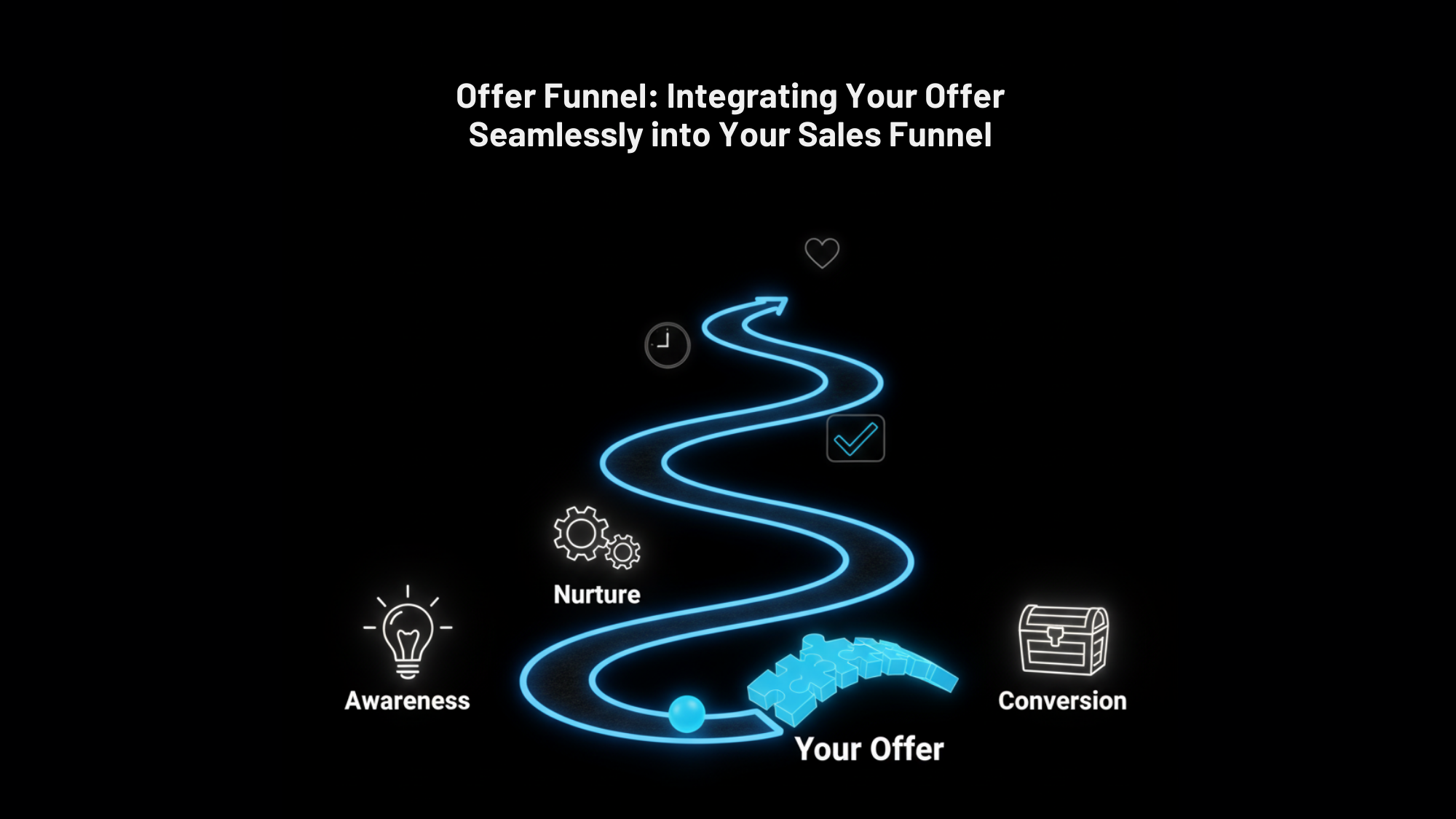
Why Your Offer Placement Matters More Than You Think
You can have the best product or service in the world, but if your offer shows up at the wrong point in your sales funnel, it’s like proposing marriage on the first date. Too soon, and prospects run. Too late, and you’ve lost their attention.
This is where the offer funnel comes in: the strategic integration of your core offer into the sales journey at the exact moment when trust, interest, and readiness align.
For business owners and marketers, understanding how to structure the offer in a sales funnel can mean the difference between a funnel that leaks leads and one that scales predictably.
What Is an Offer Funnel?
An offer funnel is the intentional design of how, when, and where your core offer is introduced inside your sales funnel. It ensures that your audience encounters your offer in a way that feels natural, timely, and compelling.
Think of it as choreography:
- Your lead magnet (free guide, webinar, checklist) sparks curiosity.
- Your nurture stage builds authority and trust.
- Your offer placement is the moment of truth — the conversion pivot.
Without this choreography, even the most brilliant offer can fall flat.
The Core Challenge: Misaligned Offers
Most stalled funnels share a common problem: the offer isn’t aligned with the customer’s journey.
- Too early: Leads haven’t had time to trust you yet.
- Too late: Interest has faded, and the momentum is gone.
- Too vague: The offer doesn’t connect back to the problem the lead signed up to solve.
If your funnel feels like it’s almost working but conversions remain low, chances are your offer funnel is misaligned.
How to Seamlessly Integrate Your Offer in a Sales Funnel
Here’s a step-by-step framework you can use to place your offer effectively:
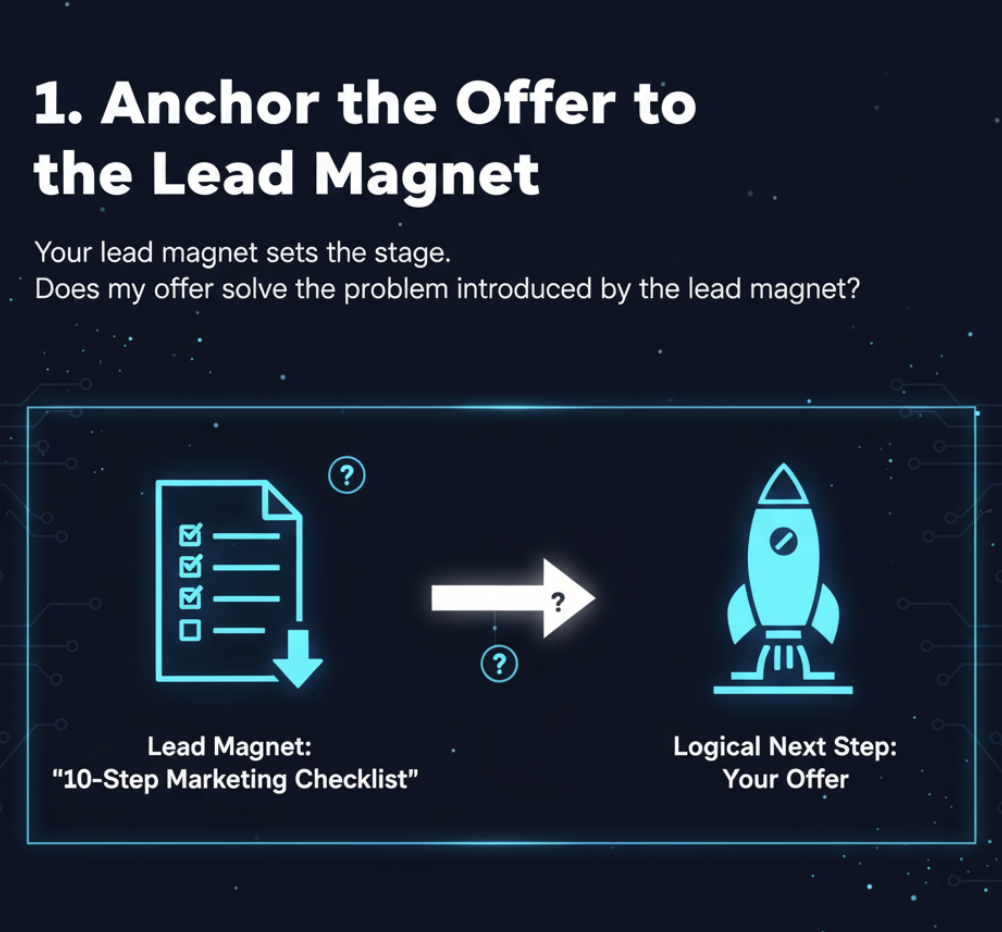
1. Anchor the Offer to the Lead Magnet
Your lead magnet sets the stage. If someone downloads your “10-Step Marketing Checklist,” your offer should naturally be the next step — not a random detour. Ask:
- Does my offer solve the problem introduced by the lead magnet?
- Can I position it as the “logical next step”?
2. Time It Right
Great offers often appear:
- At the end of a webinar (when trust is high and attention is focused).
- Right after delivering value (e.g., post free resource).
- During key decision points (like an onboarding sequence or demo).
3. Contextualize the Value
Frame your offer not as a transaction but as a transformation:
- “This isn’t just a tool; it’s the system that ensures the checklist you just used doesn’t fail.”
- “This isn’t another course; it’s the bridge between where you are and where you want to go.”
4. Reduce Friction
Make the path to ‘yes’ effortless:
- Clear pricing and payment options.
- Social proof in the right place (testimonials, case studies).
- Simple CTAs (“Book your strategy session,” “Start your free trial”).
5. Use Micro-Offers if Needed
If your main offer feels like a big leap, introduce a smaller stepping-stone offer first (e.g., a low-cost toolkit or mini-course).
A Practical Example
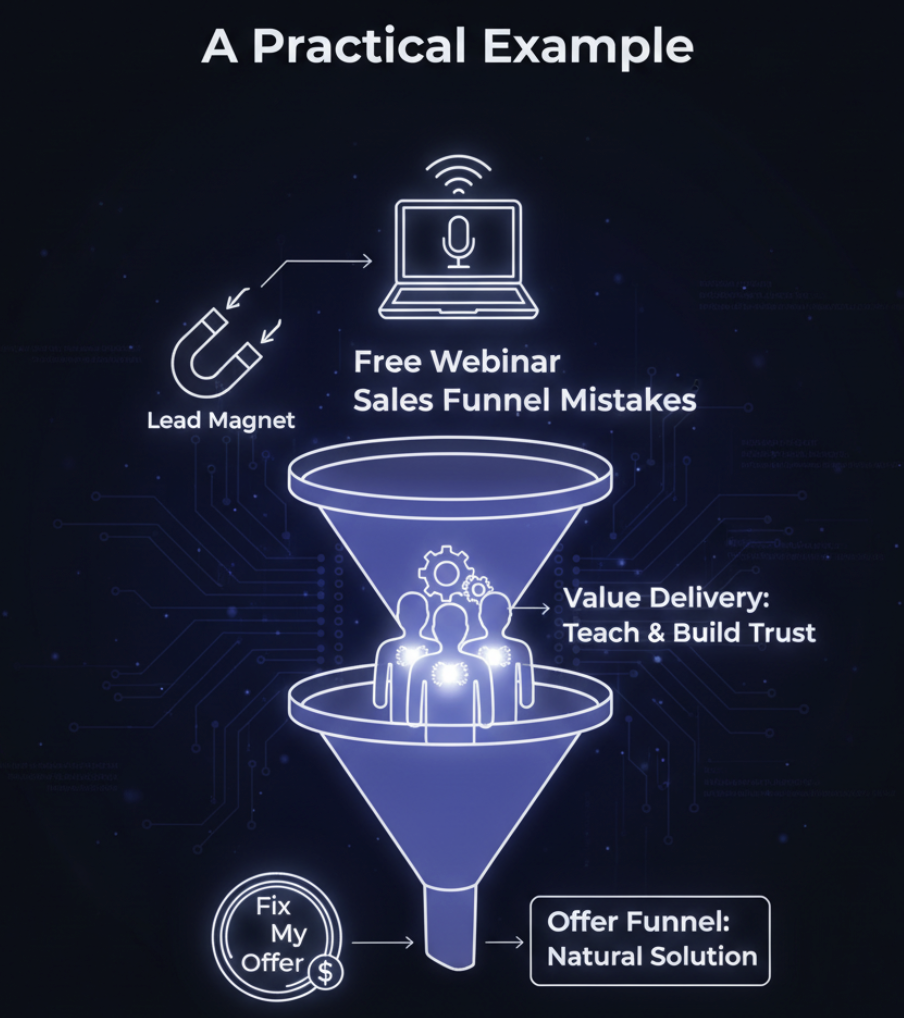
Imagine hosting a free webinar on “3 Common Sales Funnel Mistakes.”
- Lead Magnet: The webinar itself attracts an audience already interested in funnel fixes.
- Value Delivery: You teach, build trust, and showcase expertise.
- Offer Funnel: At the end, you introduce your Fix My Offer service as the direct solution to the problems you just unpacked.
The offer feels natural because it is the logical continuation of the journey — not a random pitch.
Common Mistakes to Avoid
- Treating the offer like a “final add-on” instead of the centerpiece of the funnel.
- Offering too many things at once (confusion kills conversions).
- Forgetting to link the offer back to the original pain point.
Offer Funnel Checklist
Before launching, ask yourself:
- Is my offer aligned with the lead magnet?
- Am I presenting it at the moment of peak attention?
- Does my offer feel like the next logical step?
- Have I removed unnecessary friction (confusing copy, too many clicks)?
If you can check all four boxes, you’re on track.
FAQs: Integrating Your Offer into Your Funnel
Q1: What is funnel optimization?
Funnel optimization is the process of refining each stage of your funnel — from awareness to conversion — to increase efficiency, reduce leaks, and maximize conversions.
Q2: How do I know if my offer is weak?
If prospects show interest in your content but consistently drop off when the offer appears, it may be weak (unclear value, wrong timing, or misaligned with the audience).
Q3: Should I have multiple offers in one funnel?
Yes, but with caution. Use micro-offers to guide prospects upward, but avoid overwhelming them with too many choices.
Q4: Where should I present my core offer in a webinar?
Toward the end, after you’ve delivered substantial value and built trust — but before attention wanes.
Q5: What’s the role of AI in offer funnels?
AI tools (like ActStrategic.ai’s diagnostic reports) can help pinpoint where in your funnel prospects drop off, so you know whether the issue is offer timing, positioning, or structure.
Final Thoughts: Make Your Offer Funnel Work for You
Your funnel isn’t just about capturing leads — it’s about guiding them to the right decision at the right time. The offer in a sales funnel should feel like a natural, inevitable next step. When you get this right, conversions increase, ad spend goes further, and scaling feels less like guesswork.
👉 Ready to see if your offer is holding your funnel back? Explore Fix My Offer — a strategic diagnostic that reveals exactly where your offer is misaligned.
Or, if you’re not sure whether the problem lies in your funnel design, your offer, or your website, start with Fix My Funnel or Fix My Website Conversions.
For a deeper dive into growth systems, check out ActStrategic.ai — your AI-powered strategist for business growth