Why Funnel Audits Will Be Mandatory in 2026
The rules of digital growth are changing fast. Ad platforms evolve monthly, privacy restrictions limit targeting, and customer acquisition costs keep climbing. In this environment, guessing at what’s broken in your funnel is like burning cash.
By 2026, funnel audits will move from optional to mandatory. Just like financial audits validate the health of a company, funnel audits will validate the health of your growth system. Investors, boards, and clients will expect them. Growth leaders who run audits regularly will scale confidently — while those who don’t will bleed ad spend and miss targets.
Common Funnel Challenges That Demand Audits
- Rising CAC (Customer Acquisition Cost): CAC has grown 15–20% year-over-year across most industries.
- Fragmented Funnels: Multiple platforms, disconnected tracking, broken attribution.
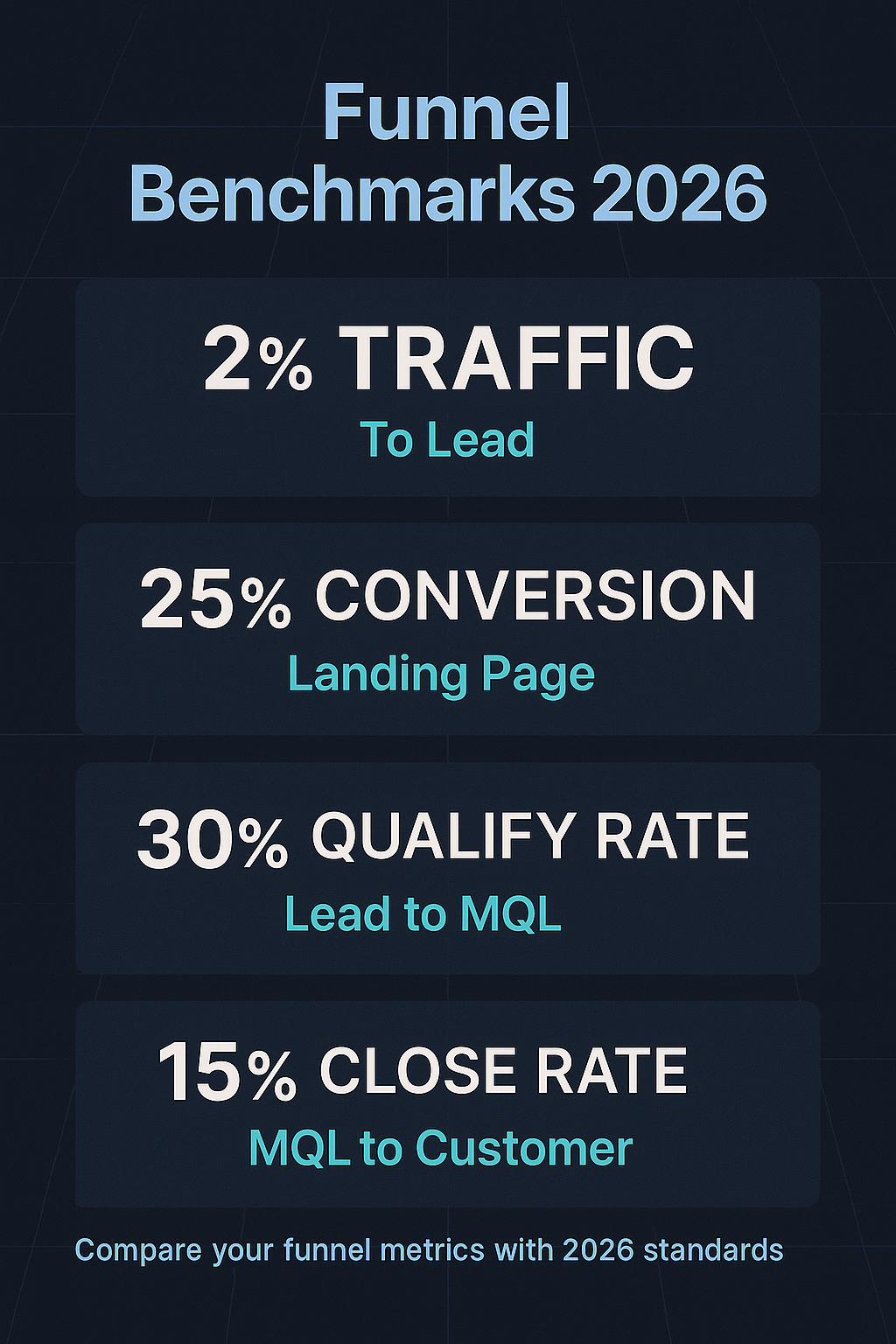
- Low Conversion Benchmarks:
- Landing page CVR baseline: 2–5%
- Email open rates: 20–25%
- Retargeting CTR: 0.7–1%
- Lack of Visibility: Leadership can’t see where revenue is leaking or which campaigns actually work.
Without audits, these problems compound — and in 2026’s market, inefficiency is a dealbreaker.
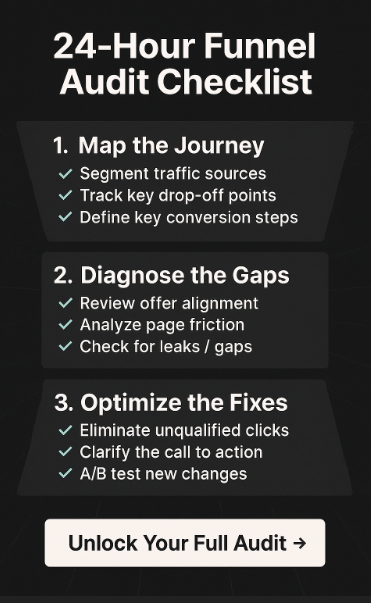
Framework: The 3 Layers of a Funnel Audit
| Layer | Focus | Example Diagnostic Questions |
|---|---|---|
| Top of Funnel | Awareness & traffic quality | Are we attracting the right ICP? Which traffic sources have the best ROI? |
| Middle of Funnel | Lead nurture & conversion | Do nurture emails get opened? Are CTAs aligned with buying intent? |
| Bottom of Funnel | Sales readiness & retention | Where do deals stall? What % of customers renew or upgrade? |
📊 Visual Tip: Add a funnel diagram showing TOFU → MOFU → BOFU, with icons for awareness (magnifying glass), nurture (email), and sales (handshake).
Step-by-Step: Running a Funnel Audit in 24 Hours
- Collect Data: Gather traffic, CVR, CAC, CLTV, and drop-off rates.
- Benchmark Against Peers: Compare your funnel against industry benchmarks (see table above).
- Spot Drop-Offs: Identify the 1–2 biggest revenue leaks.
- Prioritize Fixes: Rank by ROI impact, not effort.
- Act Quickly: Run 30–60 day experiments to validate improvements.
Mini Example:
An agency spending $50k/month on ads ran a 24-hour audit. They found a 12% drop-off between lead capture and nurture emails due to weak subject lines. After rewriting and testing new sequences, open rates improved 19% and conversions rose 22% — saving $6k/month in wasted ad spend.
Why AI Funnel Audit Tools Change the Game
Traditional audits take weeks of consulting time. By contrast, AI-powered funnel audit tools like ActStrategic.ai deliver:
- Consulting-grade reports in 24 hours
- Benchmarked insights on where funnels leak
- Step-by-step fixes with Quick Wins and Scaling Roadmaps
This makes audits not only faster but affordable — accessible to SMBs and agencies, not just Fortune 500s.

FAQs
1. What is a funnel audit?
A structured review of your sales funnel to identify leaks, inefficiencies, and opportunities to grow faster.
2. How often should I run a funnel audit?
At least once per quarter — or whenever CAC rises, CVR dips, or you launch a new campaign.
3. What tools are best for funnel audits?
AI-powered diagnostics like ActStrategic.ai combine consulting frameworks with real-time insights in 24 hours.
4. What benchmarks should growth leaders track?
- Landing page conversion rate: 2–5% baseline, 8%+ best-in-class
- Lead-to-opportunity conversion: 15–25% average
- CAC vs. CLTV ratio: Target <3:1
5. Are funnel audits only for big companies?
No. SMBs benefit most, because small leaks compound quickly in smaller budgets.
Conclusion: Growth Leaders Can’t Skip Audits in 2026
Funnel audits are no longer optional. With CAC rising, ad waste compounding, and competition intensifying, audits are the new baseline for growth leaders.
By 2026, those who embrace funnel audits will catch leaks, deploy fixes fast, and scale with confidence. Those who ignore them will fall behind.
👉 Pinpoint leaks in 24 hours with ActStrategic.ai’s Fix My Funnel report — consulting-grade clarity without the consulting fee.
More from ActStrategic.ai:
AI Strategy Consulting Examples: A Playbook to Gain Competitive Advantage