Introduction
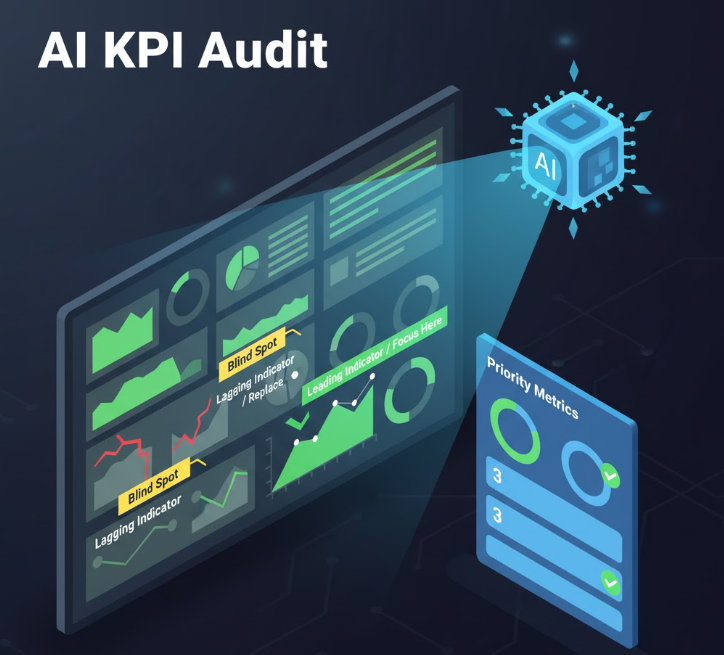
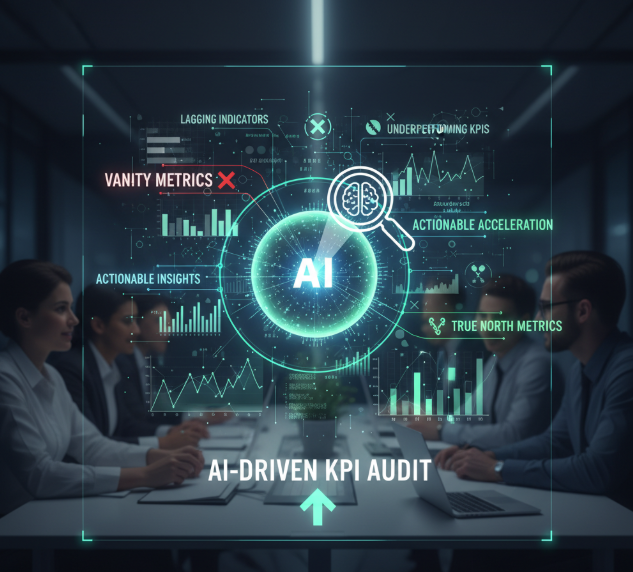
Many founders and operators struggle with understanding which metrics truly drive their business forward. It’s easy to get lost in a sea of vanity metrics, underperforming KPIs, and lagging indicators. An AI-driven KPI audit transforms how teams analyze performance, uncovering blind spots and actionable insights that accelerate growth.
Why Traditional KPI Reviews Fall Short
- Data Overload: Teams track dozens of metrics, often without prioritization.
- Lagging Indicators: Traditional KPIs often reflect past performance, not predictive insights.
- Blind Spots: Hidden inefficiencies go unnoticed until they impact revenue.
- Manual Analysis: Time-consuming reviews can delay strategic action.
How an AI-Driven KPI Audit Works
AI doesn’t just collect data—it interprets it. Here’s the process:
1. Comprehensive Metrics Review
- AI analyzes historical performance across all tracked KPIs.
- Detects trends, outliers, and inconsistencies.
- Differentiates leading vs lagging indicators for predictive insights.
Image Alt Text: “AI analyzing KPI trends on dashboard”
2. Blind Spot Identification
- Highlights underperforming or overlooked metrics.
- Detects correlations and dependencies that manual reviews miss.
- Flags risks before they affect outcomes.
3. Optimization Recommendations
- Suggests which KPIs to prioritize or retire.
- Recommends actionable strategies to improve metric performance.
- Generates AI-driven scoring models for performance tracking.
4. Automated Dashboards and Reporting
- Creates visual dashboards tailored to team objectives.
- Automates regular KPI tracking and alerts.
- Facilitates data-driven decision-making across departments.
Checklist Example: Implementing an AI KPI Audit
- Identify key business objectives.
- Collect historical KPI data.
- Run AI analysis to detect blind spots.
- Prioritize leading indicators.
- Generate dashboards and automate reporting.
- Review and refine regularly based on insights.
Common Mistakes Without AI
- Relying on outdated or irrelevant KPIs.
- Ignoring predictive indicators in favor of lagging metrics.
- Conducting audits manually, delaying action.
- Failing to communicate insights to stakeholders clearly.
FAQ Section
Q1: How does KPI audit AI differ from manual reviews?
AI analyzes data faster, identifies hidden patterns, and provides predictive insights beyond traditional spreadsheets.
Q2: Can AI determine which KPIs are most impactful?
Yes, AI prioritizes KPIs based on correlation with business outcomes and leading indicator potential.
Q3: How often should I run an AI-driven KPI audit?
Ideally, align with strategic review cycles—monthly, quarterly, or when launching new initiatives.
Q4: Will AI replace human analysts?
No, AI complements human expertise by accelerating insights and reducing decision fatigue.
Q5: What tools are recommended for AI KPI audits?
Platforms with predictive analytics, KPI dashboards, and automated reporting are ideal, such as ActStrategic.ai tools.
Conclusion
Unlock actionable insights with an AI-driven KPI audit. Explore ActStrategic.ai tools to analyze your funnel with a Fix My Funnel report, optimize offers with Fix My Offer, or enhance conversions using Fix My Website Conversions.