Introduction: The Hidden Threats Founders Miss
Every founder knows that surprises can derail a business — whether it’s a sudden cash crunch, unexpected churn, or operational bottlenecks. Most strategy failures happen because risks aren’t identified early. AI risk analysis transforms uncertainty into foresight, helping you spot potential problems before they become costly.

How AI Predicts Business Risks
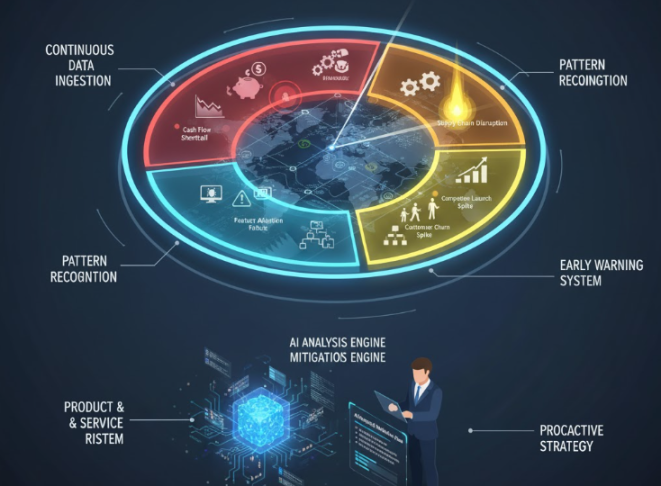
AI risk tools combine historical data, predictive modeling, and pattern recognition to forecast potential business issues across multiple domains:
1. Financial Risks
- Cash flow alerts: Predict shortfalls based on historical revenue and expense patterns.
- Investment risks: Evaluate potential ROI and flag risky ventures early.
2. Operational Risks
- Workflow bottlenecks: Identify processes prone to delays.
- Resource allocation: Forecast staffing needs and prevent overcommitment.
3. Customer & Market Risks
- Churn prediction: Detect early signs of customer attrition.
- Market trend shifts: Spot declining demand or emerging competition.
4. Product & Service Risks
- Feature adoption: Evaluate if new features meet user needs.
- Quality control: Predict potential issues in production or service delivery.
5. Team & Talent Risks
- Employee attrition: Identify team members likely to leave.
- Skill gaps: Forecast future skill shortages impacting strategy execution.
Frameworks & Tools for Predictive Risk Detection
- AI Scoring Models
- Assign risk scores to projects, customers, or campaigns.
- Prioritize actions based on severity.
- Scenario Simulations
- Test “what-if” situations before making critical decisions.
- Visualize potential impacts across the business.
- Continuous Monitoring Dashboards
- Track KPIs in real time.
- Receive automated alerts for deviations.
- Integration With Strategy Tools
- Connect AI risk insights to funnel audits, offer optimizers, and conversion reports.
- Example: ActStrategic.ai funnel report integrates risk flags directly into your sales and marketing evaluation.
Common Mistakes Founders Make
- Ignoring small signals: Minor anomalies often precede larger issues.
- Relying solely on intuition: Human judgment is biased and limited.
- Disjointed tools: Not centralizing risk insights leads to fragmented decision-making.
- Delayed action: Detecting a risk but failing to act is as bad as not detecting it at all.
FAQs
Q1: What types of business risks can AI predict?
A1: Financial, operational, customer, product, and team-related risks, often before they manifest.
Q2: How accurate is AI risk analysis?
A2: Accuracy depends on data quality, model sophistication, and continuous updates. Best practices combine AI insights with expert human judgment.
Q3: Can AI risk tools integrate with marketing and sales platforms?
A3: Yes, tools like ActStrategic.ai offer funnel and offer integration for seamless insights.
Q4: Is AI risk analysis only for large enterprises?
A4: No, SMBs can also leverage predictive analytics for early risk detection and smarter growth decisions.
Q5: How often should risk models be updated?
A5: Ideally, continuously. Automated dashboards ensure alerts are always based on current data
Conclusion
Predictive insights turn guesswork into strategy. Explore how ActStrategic.ai tools can help you identify risks, optimize your offers, and ensure your business stays ahead of challenges.