
The Silent Killer of Growth: A Leaky Website Funnel
You’ve got the traffic. The ads are running. Your brand looks polished. Yet, conversions remain frustratingly low.
If that sounds familiar, you’re not alone. Many business owners and marketers face this exact challenge — a website that looks great but doesn’t convert visitors into paying customers.
The truth? Most conversion problems aren’t about design flair — they’re about strategic clarity. Your website should act like a well-oiled sales machine: guiding visitors from curiosity to action with minimal friction.
At ActStrategic.ai, we specialize in diagnosing these leaks. In this guide, we’ll walk you through a practical, data-driven process to increase your website’s conversion rate — step by step.
Step 1: Define What “Conversion” Means for Your Business
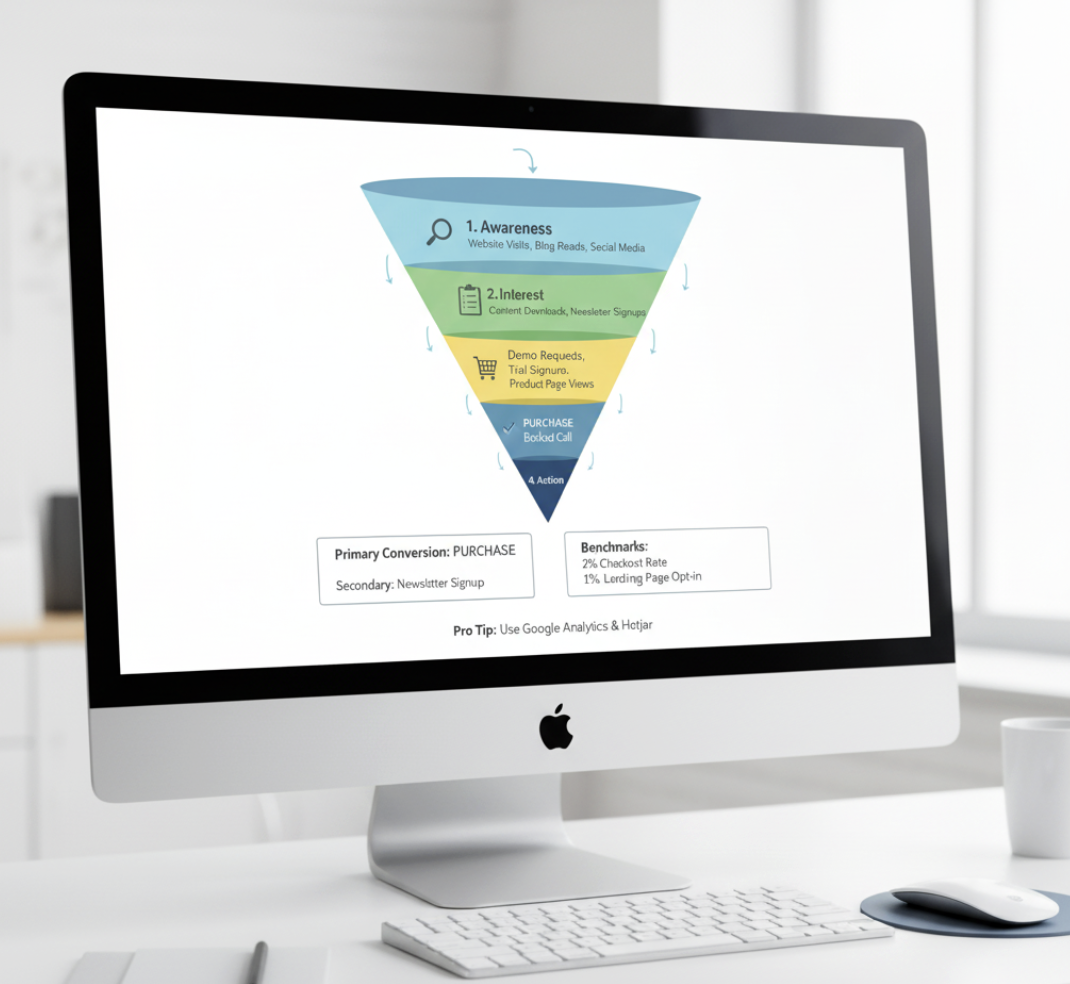
Before you fix conversion problems, you need clarity on what success looks like. A “conversion” isn’t always a sale — it could be a booked call, demo request, or newsletter signup.
Action Steps:
- Identify your primary and secondary conversions (e.g., purchase, trial signup, lead form).
- Map these to each stage of your funnel: Awareness → Interest → Decision → Action.
- Set benchmarks (e.g., 2% checkout rate, 15% landing page signup rate) to measure improvements.
Pro Tip: Use analytics tools like Google Analytics 4 or Hotjar to track visitor behavior and pinpoint where people drop off.
Step 2: Audit Your Messaging and Offer Clarity
Even the most beautiful website fails if your value proposition isn’t instantly clear. When someone lands on your site, they should be able to answer in 5 seconds:
- What do you do?
- Who is it for?
- Why should I care?
Fix This By:
- Crafting a headline that communicates a clear benefit (not just features).
- Using subheadlines or bullets to highlight proof points (e.g., social proof, results, guarantees).
- Removing jargon — speak your audience’s language.
If your visitors can’t “get it” fast, they’ll bounce — not because they’re disinterested, but because they’re confused.
Step 3: Refine Your Calls-to-Action (CTAs)
Your CTA is the bridge between interest and conversion. Yet, many sites bury or weaken this moment.
High-Converting CTA Checklist:
✅ Use clear, action-oriented language (e.g., “Start My Free Audit” instead of “Submit”).
✅ Make CTAs visually distinct with contrasting colors.
✅ Place them strategically — above the fold, mid-page, and at logical decision points.
✅ Match CTAs to intent (don’t ask for a sale too early).
Think of your CTAs as “micro-yeses” — each one moves your visitor a little closer to taking action.
Step 4: Simplify Forms and Checkout Processes
If you’ve ever abandoned a form because it felt too long or complicated, your visitors have too.
How to Fix It:
- Keep forms short — only ask for what’s essential.
- Use multi-step forms for complex processes (they feel less intimidating).
- Offer autofill and mobile-friendly layouts.
- Test removing unnecessary fields (each one adds friction).
According to a HubSpot study, reducing form fields from 11 to 4 can increase conversions by over 120%.
Step 5: Improve Page Load Speed and Mobile Experience
A slow site doesn’t just frustrate users — it kills conversions. Google research shows that a 1-second delay in load time can reduce conversions by 20%.
Quick Fixes:
- Compress large images and enable lazy loading.
- Use a CDN to speed up delivery.
- Remove unnecessary plugins or scripts.
- Test your site on Google PageSpeed Insights.
Also, ensure your mobile experience is seamless — responsive design, easy navigation, and click-friendly buttons.
Step 6: Analyze Drop-Off Points with Data
Use data — not guesswork — to find your biggest conversion leaks.
Tools to Use:
- Heatmaps (Hotjar, CrazyEgg): See where users click or stop scrolling.
- Session Recordings: Watch real visitor sessions to understand behavior.
- Funnel Analytics: Track which step loses the most users.
Once you know where people drop off, you can test hypotheses (e.g., “Are users confused by pricing?” or “Is my CTA too far down?”).
Conversion optimization isn’t a one-time project — it’s an ongoing experiment.
Step 7: Test, Measure, and Iterate
The most successful companies continuously test everything — headlines, CTAs, pricing, images.
A/B Testing Tips:
- Change one variable at a time.
- Let tests run long enough to collect meaningful data.
- Prioritize changes with high potential impact (based on funnel data).
Use insights to refine — not reinvent — your strategy.

Bonus: Leverage AI Tools to Diagnose and Fix Conversion Issues
AI-driven analysis tools like ActStrategic.ai’s Fix My Website Conversions can rapidly identify weak points in your funnel — from unclear messaging to form friction.
You’ll get a custom strategy report outlining:
- Your top 3 conversion bottlenecks
- Actionable fixes prioritized by impact
- Benchmarks to measure progress
Because sometimes, what you need isn’t more traffic — it’s clarity.
FAQs About Increasing Website Conversion Rates
1. What is a good website conversion rate?
It varies by industry, but the average is around 2–5%. High-performing sites often reach 10% or more.
2. How often should I review my website’s conversion performance?
Monthly reviews are ideal, but significant funnel changes warrant weekly check-ins.
3. What’s the biggest mistake people make with conversion optimization?
Focusing on design tweaks without understanding messaging, offer alignment, or user intent.
4. Do I need expensive software to optimize my website?
No. Tools like Google Analytics, Hotjar, and ActStrategic.ai’s reports provide actionable insights affordably.
5. How do I know if my offer is weak?
If users engage but don’t convert, your offer might not feel urgent, clear, or valuable enough — test new angles or bonuses.
Final Thoughts: Clarity Converts
Improving your website’s conversion rate isn’t about tricks — it’s about understanding your visitors and removing friction at every step.
If you’re ready to see exactly where your funnel is leaking, explore our Fix My Website Conversions tool. You’ll gain clarity, direction, and a roadmap for measurable growth.
ActStrategic.ai — Strategic clarity for business owners who want to scale smarter.