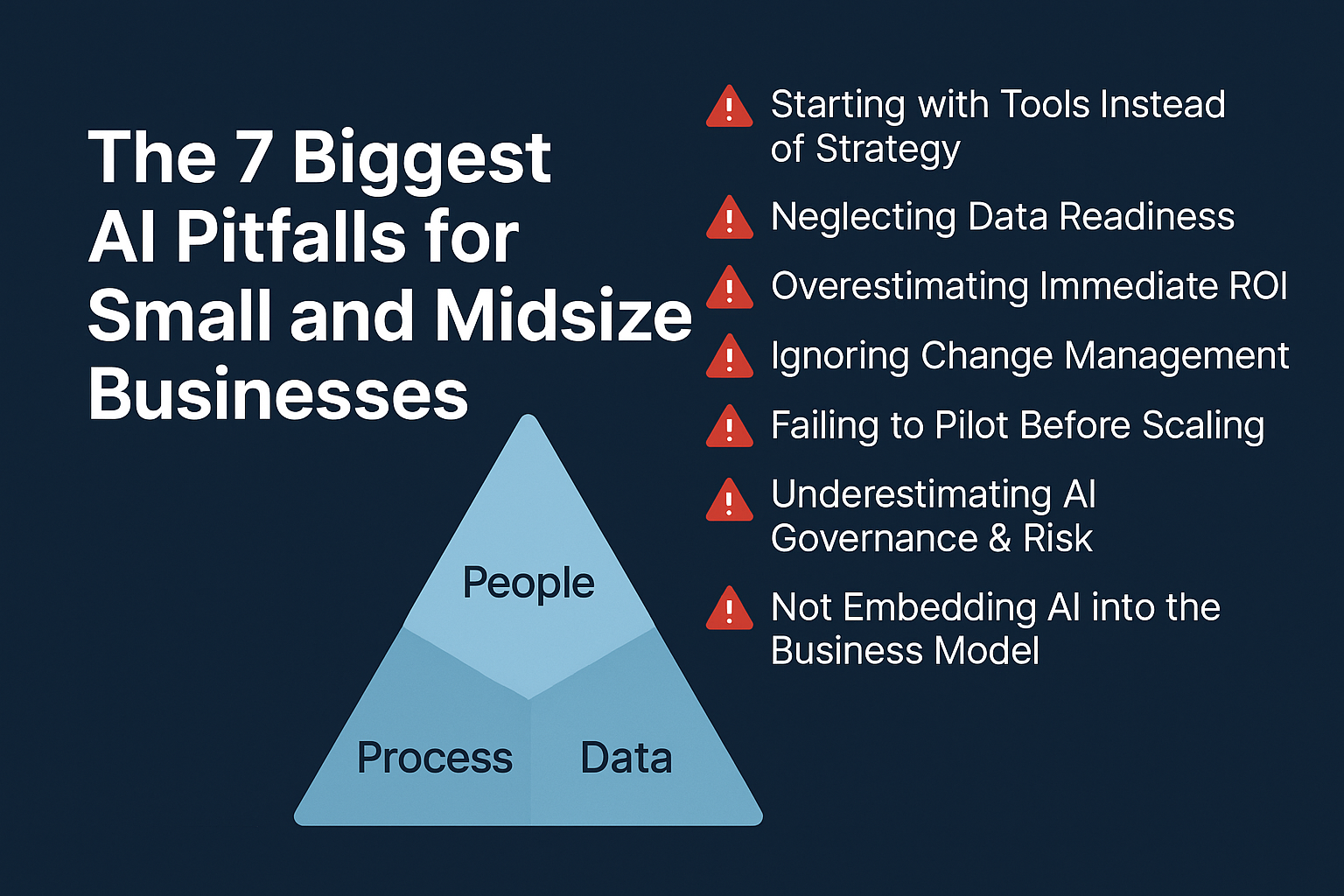
Introduction: Why AI Fails for Many SMBs
McKinsey reports that fewer than 30% of AI initiatives deliver measurable ROI. For small and mid-sized businesses (SMBs), where margins are tighter and leadership teams wear multiple hats, the risks are even greater.
The most common failure pattern? Leaders buy tools without a strategy. Budgets get burned, teams lose confidence, and projects stall before results appear.
At ActStrategic.ai, we believe these failures are avoidable. By understanding the seven most common SMB AI adoption challenges, executives can steer toward ROI with clarity, benchmarks, and proven frameworks.
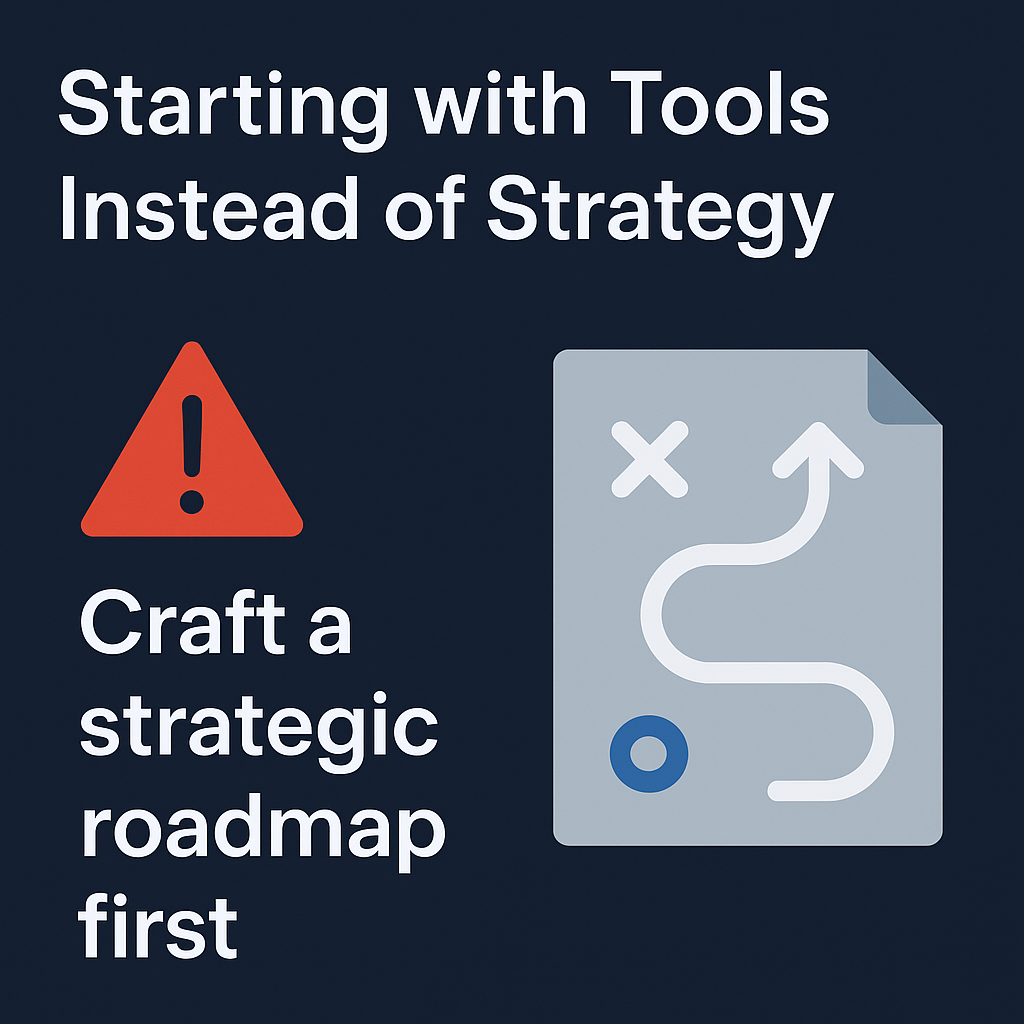
1. Starting with Tools Instead of Strategy
SMBs often succumb to “shiny object syndrome,” piloting tools that don’t connect to the business model.
Framework: BCG Growth-Share Matrix (AI Adaptation)
- Stars: High ROI & adoption (AI-driven customer service).
- Cash Cows: Proven efficiency plays (predictive maintenance).
- Question Marks: Experiments needing proof (generative AI in marketing).
- Dogs: Low-value distractions.
Counter-Strategy for Executives:
- CEO: Ask—Does this initiative link directly to our strategic priorities?
- CFO: Demand a business case with ROI benchmarks.
- COO: Insist pilots align with operations workflows, not sit in silos.
Benchmark: Harvard Business Review notes firms linking AI to strategy are 2.5x more likely to achieve ROI.
2. Neglecting Data Readiness
Without quality data, AI cannot succeed. Gartner estimates 80% of AI project time is spent cleaning and labeling data.
Framework: People–Process–Data Alignment Model
- People: Who owns governance?
- Process: How consistently is data captured?
- Data: Is it accurate, accessible, structured?
Counter-Strategy:
- CFO: Audit financial and CRM data first—those drive immediate ROI.
- COO: Implement small-scale governance practices now (naming conventions, access policies).
3. Overestimating Immediate ROI
AI follows the Growth S-Curve: flat progress before exponential impact. Leaders often misjudge the timeline.
ROI Benchmarks:
- Phase 1: 5–10% efficiency savings.
- Phase 2: 15–25% process automation gains.
- Phase 3: 20–30%+ revenue growth.
Counter-Strategy:
- CEO: Set realistic board expectations (6–18 months to scale).
- CFO: Phase ROI targets—don’t expect payback in month one.
4. Ignoring Change Management
Prosci research shows projects with strong change management are 6x more likely to succeed. Yet SMBs rarely budget for it.
Framework: Kotter’s 8-Step Change Model (Simplified)
- Build urgency (quantify cost of inaction).
- Form a coalition (cross-functional leaders).
- Empower adoption (training, incentives).
- Anchor success in KPIs.
Counter-Strategy:
- CEO: Sponsor change visibly.
- COO: Assign adoption champions in each function.
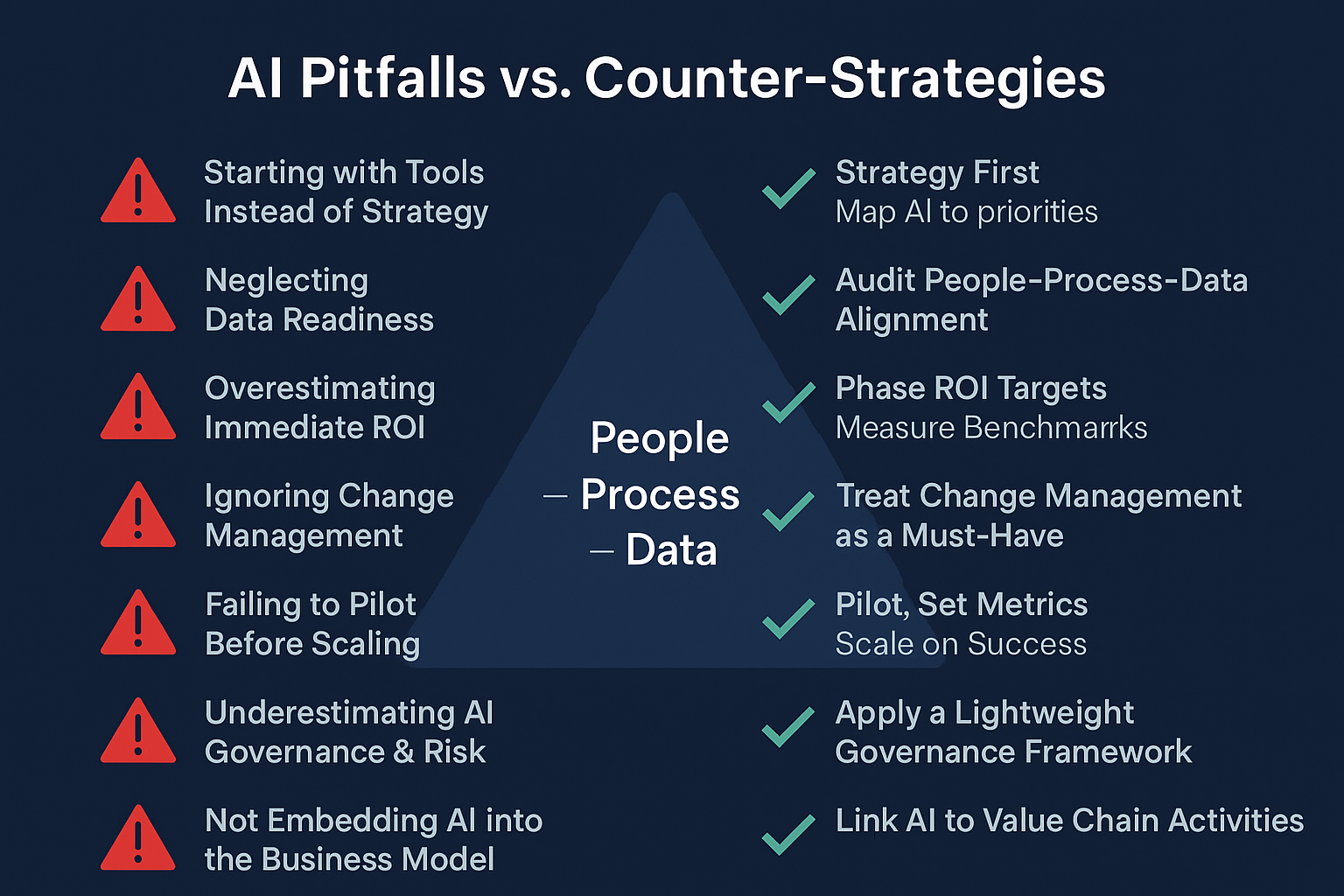
5. Failing to Pilot Before Scaling
Rolling out AI across the enterprise without proof points is a recipe for failure.
Framework: Lean Startup for AI
- MVP: Small, testable version.
- Pilot: Adoption, accuracy, ROI tracked.
- Scale: Roll out only when validated.
Counter-Strategy:
- CFO: Approve budget only after pilots hit metrics (e.g., >70% adoption).
- COO: Track pilot outcomes as rigorously as financial results.
6. Underestimating AI Governance & Risk
AI introduces compliance, bias, and privacy risks. SMBs assume governance is only for Fortune 500s—dangerous mistake.
Framework: AI Risk-Reward Matrix
- High Reward / High Risk: Customer-facing chatbots.
- High Reward / Low Risk: Back-office automation.
- Low Reward / High Risk: Sensitive models with weak safeguards.
- Low Reward / Low Risk: Experiments without business value.
Counter-Strategy:
- CEO: Approve a governance policy, even if lightweight.
- CFO: Ensure compliance with data-use laws.
- COO: Define fail-safes for mission-critical AI systems.
7. Not Embedding AI into the Business Model
Treating AI as an “add-on” undermines long-term ROI.
Framework: Porter’s Value Chain
- Primary Activities: AI in operations, marketing, service.
- Support Activities: AI in HR, IT, procurement.
Counter-Strategy:
- CEO: Ask which value chain link AI transforms.
- CFO: Map ROI back to cost centers and revenue drivers.
- COO: Integrate AI into daily workflows, not side projects.
⚡ Quick Wins Box: De-Risk AI Immediately
- ✅ Run a 30-minute AI readiness assessment (People–Process–Data).
- ✅ Launch one low-risk pilot with ROI metrics built in.
- ✅ Build a 3-step change management plan (urgency, coalition, training).
- ✅ Audit financial and CRM data for accuracy.
- ✅ Apply a governance checklist before launch.
Case Example: Healthcare Contact Center
A mid-sized healthcare provider avoided pitfalls by mapping AI into its value chain.
- Approach: Piloted an AI-powered agent assistant.
- Results:
- 30% reduction in call handle time.
- $1.2M annual savings.
- 85%+ employee adoption through structured change management.
Why It Worked: The CEO aligned strategy, the CFO approved ROI gates, and the COO drove adoption.
Visual Suggestion: Benchmark ROI Curve
Insert a chart showing the AI Growth S-Curve with ROI benchmarks:
- X-axis: Time (quarters).
- Y-axis: ROI %.
- Curve labels: Phase 1 (5–10%), Phase 2 (15–25%), Phase 3 (20–30%+).
This visual reinforces realistic timelines for executives.
What’s Next?
Avoiding pitfalls is step one. To accelerate ROI, explore:
FAQ: AI Pitfalls for SMBs
1. What’s the biggest AI pitfall for SMBs?
Starting with tools instead of strategy. Link AI to business priorities first.
2. How much should SMBs budget for AI projects?
Successful pilots often range $50K–$150K, depending on scope.
3. Can AI deliver quick ROI?
Yes—but most ROI emerges after 6–18 months.
4. Do SMBs really need AI governance?
Absolutely. Even lightweight governance builds trust and mitigates risk.
5. How do I know if my data is AI-ready?
Audit for accuracy, completeness, and accessibility. Start with CRM and financials.
Final Word
AI is not a silver bullet—it’s a strategic lever. SMBs that avoid these seven predictable pitfalls create a durable competitive edge, not a sunk cost.
At ActStrategic.ai, we equip CEOs, CFOs, and COOs with framework-driven, ROI-focused adoption strategies. The businesses that win with AI aren’t the first to buy tools—they’re the first to align AI with strategy.