
Introduction: Why SEO Still Matters in 2025
If your website isn’t showing up where your customers are searching, it’s not just a missed opportunity—it’s money left on the table. Search is still one of the most reliable sources of long-term traffic and leads. Yet, many businesses underinvest in SEO because they assume it’s either too technical or too slow to yield results.
Here’s the truth: modern SEO isn’t about gaming algorithms—it’s about creating clarity, speed, and value for both humans and search engines. Let’s break down the most effective, up-to-date SEO strategies to help you boost website traffic and turn visitors into conversions.
1. Start with Smart Keyword Research
Before you create a single piece of content, you need to know what your audience is actually searching for.
Actionable Steps:
- Use tools like Google Keyword Planner, Ahrefs, or Ubersuggest to find high-volume, low-competition keywords.
- Focus on intent, not just volume — what problem does the user want to solve?
- Target a mix of head terms (e.g., “SEO tips”) and long-tail phrases (e.g., “SEO tips for website traffic in 2025”).
Pro Tip: Incorporate keywords naturally into headlines, meta descriptions, and the first 100 words of your page.

2. Optimize Your On-Page Elements
Small technical details have a big impact on visibility and engagement.
Checklist:
- ✅ Include your target keyword in your title, H1, and meta description.
- ✅ Use short, descriptive URLs (e.g.,
yourdomain.com/seo-tips). - ✅ Add internal links to relevant ActStrategic.ai pages such as ActStrategic.ai and Fix My Website Conversions.
- ✅ Optimize images (use alt text and compress for speed).
Why it matters: Clear structure helps Google understand your content—and makes it easier for readers to navigate.
3. Improve Site Speed and Mobile Experience
In 2025, site performance is non-negotiable. Google’s Core Web Vitals measure how fast and stable your site feels for users. A slow or clunky website can tank rankings—and conversions.
Quick Wins:
- Use tools like PageSpeed Insights to check performance.
- Compress large images and leverage browser caching.
- Simplify design elements and remove unnecessary scripts.
Pro Tip: Every second of load time can reduce conversions by up to 7% (source: Neil Patel).
4. Build High-Quality Backlinks
Backlinks remain one of the strongest ranking signals—but it’s quality over quantity.
Effective Strategies:
- Create shareable, insight-rich content (like case studies or frameworks).
- Guest post on authoritative industry sites.
- Partner with trusted directories or associations.
Pro Tip: A single backlink from a high-authority site like TechCrunch can outperform dozens of low-quality links.
5. Create Content That Converts
Search engines reward content that keeps people engaged—and people reward content that solves real problems.
Framework for Conversion-Focused Content:
| Element | Purpose |
|---|---|
| Hook | Grab attention with a relatable problem |
| Value | Offer clear, actionable insights |
| Proof | Include data, case studies, or examples |
| Next Step | Use a soft CTA (e.g., “Explore Fix My Funnel report”) |
6. Measure and Iterate
SEO isn’t one-and-done—it’s continuous optimization.
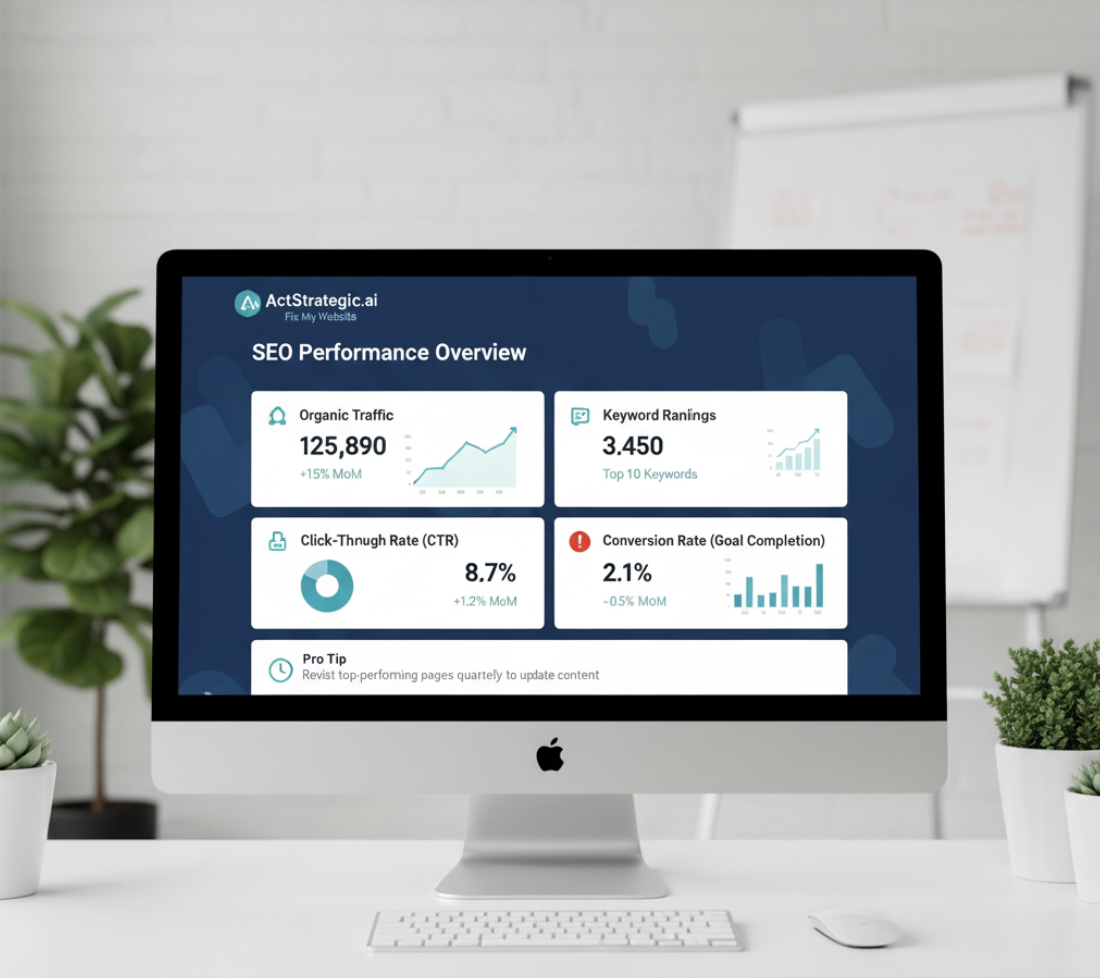
Track These KPIs:
- Organic traffic (Google Analytics)
- Keyword rankings (Ahrefs or SEMrush)
- Click-through rates (Search Console)
- Conversion rate (ActStrategic.ai Fix My Website report)
Pro Tip: Revisit your top-performing pages quarterly and update with new data or examples.
FAQs: SEO Tips for Website Traffic
1. How long does SEO take to show results?
Typically, you’ll see meaningful traction within 3–6 months, depending on your competition and consistency.
2. Do I need backlinks to rank?
Yes, backlinks from reputable sites act as trust signals for Google, improving your domain authority.
3. What’s more important: content or technical SEO?
Both. Technical SEO ensures your site is crawlable; content drives engagement and conversions.
4. Should I use AI for SEO content creation?
Absolutely—but with human oversight. Use tools like ChatGPT or My Magic Prompt for ideation, then refine for clarity and tone.
5. How do I know if my SEO is working?
Watch for increased organic traffic, improved keyword rankings, and lower bounce rates.
Conclusion: Treat SEO as a System, Not a Hack
The businesses winning in SEO today are those that treat it as a growth system—not a one-off tactic. Your website should continuously attract, educate, and convert, even while you sleep.
If your site isn’t pulling its weight yet, it’s time to find out why.
👉 Explore our Fix My Website Conversions Report to uncover where your traffic is leaking—and how to turn it into consistent sales.